29 April 2026
Key insights
-
-
- Independent higher education plays a system‑wide economic role, supporting activity and employment well beyond the education sector and contributes approximately $8.16 billion to Australia’s GDP
- The sector’s impacts ripple through the economy. For every $3 of value added generated directly by the sector, around one additional dollar of value added is supported elsewhere in the economy.
- The independent higher education sector supports 18,900 jobs. Importantly, this includes both on-campus, indirect or flow on impacts of the sector as well as the net effects on the Australian labour market of international student participation in the workforce.
-
Why economy‑wide evidence matters in a changing higher education landscape
Independent higher education has become an increasingly important part of Australia’s tertiary education system. Independent providers educate a growing share of students, play a central role in postgraduate and specialist education, and are deeply embedded in Australia’s international education ecosystem. Despite this, public and policy discussions of higher education have often focused on publicly funded universities, with limited attention given to the broader economic role of independent providers.
This presents a challenge for industry bodies and policymakers alike. Without credible, economy‑wide evidence, it is difficult to articulate how independent higher education contributes to national prosperity, workforce capability and productivity. Traditional sector metrics capture enrolments or institutional activity, but they do not explain how education interacts with labour markets, households, supply chains and long‑term economic performance.
The Independent Higher Education Australia (IHEA) report was commissioned to address this gap, providing a comprehensive assessment of the sector’s economic contribution using a modelling framework capable of capturing both immediate
activity and longer‑term effects.
Moving beyond traditional impact analysis
A central insight from the analysis is that education cannot be assessed using narrow or partial measures. Higher education affects the economy through multiple channels, many of which extend well beyond the institutions themselves.
To capture this complexity, the analysis applied a computable general equilibrium (CGE) framework. Unlike simpler input–output approaches, CGE modelling allows the economy to adjust in response to changes in activity. It captures how industries compete for labour and capital, how households respond to income changes, and how activity in one sector influences outcomes across the economy.
This approach is particularly important for higher education. Education is both a service sector and an investment in human capital. Its economic footprint includes institutional operations, student spending, labour market participation while studying, and productivity improvements that persist long after graduation. An economy‑wide framework is essential to ensure these effects are captured consistently and credibly.
Key findings: the scale of economic contribution
Using this economy‑wide framework, the analysis found that independent higher education makes a substantial contribution to the Australian economy.
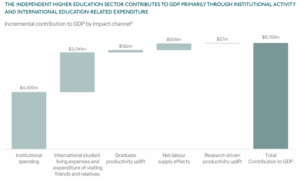
In 2025, the sector was estimated to contribute approximately $8.16 billion to Australia’s GDP, comprising both direct activity within the sector and flow‑on effects across the wider economy. Of this total, around $6.33 billion was generated directly by independent higher education activity, with a further $1.83 billion arising through indirect and induced effects. This implies a value‑add multiplier of 1.29, meaning that for every three dollars of value added generated directly by the sector, around one additional dollar of value added is supported elsewhere in the economy.
The sector was also estimated to support approximately $14.04 billion in total output across all industries in 2025, reflecting the broad reach of independent higher education activity through supply chains and service industries.
In income terms, the production and employment activity supported by the sector translated into an estimated $13.13 billion in total incomes across the economy, accruing to households, government and savings.
The report also estimated that the independent higher education sector supported around 18,900 jobs across the economy. Importantly, this is not just on‑campus employment. The estimate reflects economy‑wide employment supported, captured through the CGE modelling framework, including:
-
-
- Direct employment within independent higher education providers
- Indirect employment supported through supplier industries
- Induced employment generated by household spending associated with wages
- Labour market effects, including:
- Employment supported by international student participation in the workforce
- Net effects after accounting for reduced labour supply among domestic students while studying
-
Multiple channels of economic impact
One of the most important insights from the analysis is the diversity of channels through which independent higher education contributes to economic activity.
Institutional operations are a major driver of impact. Operating and capital expenditure by independent providers supports employment and output directly within the sector and indirectly through supply‑chain linkages to other industries.
International education‑related activity is another critical channel. International students account for the majority of the sector’s economic contribution, reflecting both education services and associated household expenditure such as accommodation, transport and retail spending, as well as spending by visiting friends and relatives. Overall, international students were estimated to account for more than 90 per cent of the sector’s total contribution to GDP.
Labour market effects also play an important role. International students contribute additional labour supply while studying, partially offset by reduced labour supply among domestic students undertaking study. When considered together, these effects make a net positive contribution to economic activity.
Finally, productivity effects matter. Higher labour productivity associated with graduates and spillovers from research activity provide additional, longer‑term contributions to economic performance. While smaller in magnitude than expenditure‑based impacts, these effects reflect the enduring role of higher education in supporting Australia’s productive capacity.
Contributions that extend across industries
The economic contribution of independent higher education is not confined to the education sector. While education records the largest direct impact, flow‑on effects extend across professional services, accommodation and food services, transport, finance and other service‑oriented industries.
This highlights an important policy insight: higher education should not be viewed as a stand‑alone sector, but as a foundational part of the economic system that supports activity and employment across a wide range of industries. At the same time, the economy‑wide framework makes clear that some trade‑exposed sectors experience offsetting effects as resources are reallocated, reinforcing the importance of a whole‑of‑economy perspective when interpreting results.
Beyond what can be modelled
While the CGE framework provides a robust and transparent assessment of economic contribution, the analysis also recognises its limits. Not all benefits of higher education can be readily quantified within an economic model.
Higher educational attainment is associated with broader social and economic benefits, including improved health outcomes, higher workforce participation, and greater adaptability in the face of structural change. By clearly separating quantified economic impacts from these broader benefits, the report strengthens the credibility of its findings and provides a balanced evidence-base for policy discussion.

Download the report


 Discover more Insights
Connect with our team
Contact